
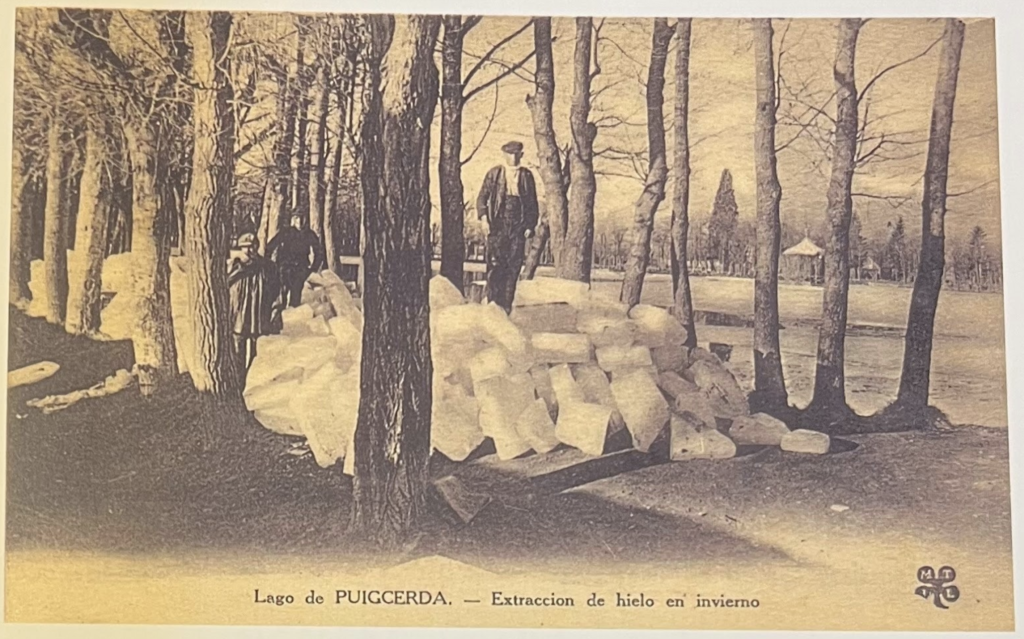
The lake of Puigcerdà is much more than a landscape element: it is a space deeply linked to the history, daily life and urban transformation of the town. Archaeological research has shown that, at least since the mid-13th century, there was already a small pond in the place where the lake now stands, surrounded by some buildings.
For centuries, the main function of the pond was essentially practical. The stored water served for irrigation, sewer cleaning, fire fighting and, to a lesser extent, as drinking water.

From the modern age, between the sixteenth and eighteenth centuries, the lake expanded its uses. The fishing of trout, barbel, catfish and eels for food, the extraction of sand and mud, the latter used as agricultural fertilizer, and also the production of ice, which during the winter months was cut into large blocks for later use, are documented. The healthiness of the pond was a constant concern, especially in the 18th and 19th centuries, in a context marked by the fear of contagions and epidemics. For this reason, several cleanings were carried out over time, documented in 1806, 1885, 1927, 1933, 1984, 1984, 1992, 2005 and, more recently, in 2020.
As for the fauna, ducks probably arrived naturally from its origins, while swans were probably introduced for the first time in 1928. Throughout the 20th century, the lake also became a source of cultural and literary inspiration, appearing in numerous writings and works by prominent authors, such as Narcís Oller.