
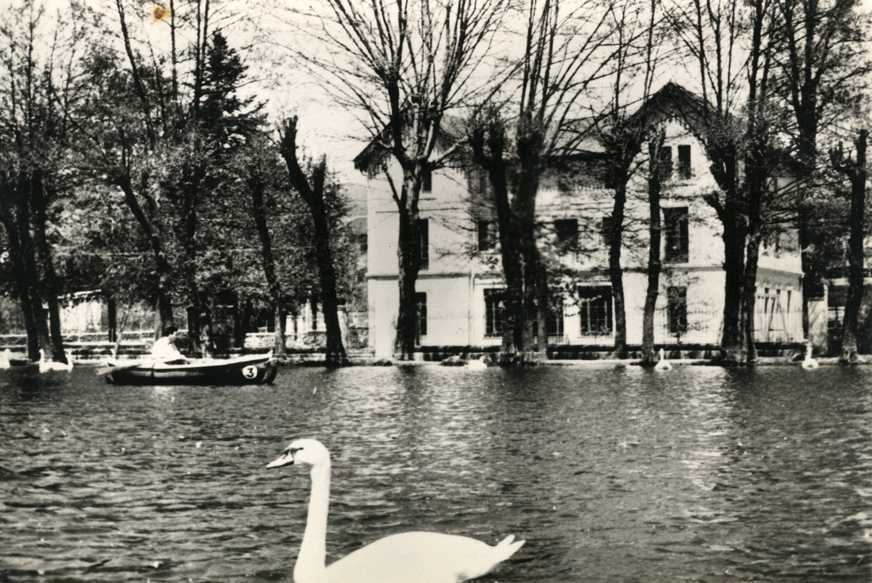
In the mid-nineteenth century, the attractiveness of the Cerdan climate, the landscape and the liberal mood of Puigcerdà led to the emergence of a phenomenon that would profoundly transform the town: the summer around the lake. The bourgeoisie and the intelligentsia -especially from Barcelona- began to settle there on a regular basis for health and leisure purposes.
Already in 1855 the foreign press echoed this new custom, although the phenomenon was definitively consolidated after the third and last Carlist war, from 1875 onwards. During this period, the main urban transformations of the area around the pond were promoted. Many families settled there, first staying in the large hotels and later building their own summer residences.
As Jaume Bragulat explains in a 1969 publication, a key figure in this development was Dr. Salvador Andreu, who around 1891 promoted various constructions around the lake. His main tower – the current orange-colored house – was surrounded by an extensive park with statues, waterfalls, tennis courts and swimming pools.
Several villas were built around it:
- Chalet Maria, today’s Torreta del Lago, intended to house the service.
- Torre Matilde, the blue and white house located next to the Torreta del Lago, built for his daughter Matilde.
- Clock Tower, located at the beginning of Doctor Andreu Street, for his daughter Francesca.
- Orange Tower.
- And the Antiguo Hotel del Lago, initially Dr. Andreu’s lodging and later a hotel.
Other prominent families also built their own summer towers:
- Torre Volart, currently Hotel Villa Paulita.
- Torre Font, today Puigcerdà Municipal School of Music.
- Villa Sant Antonio, which during the Civil War sheltered 130 boys and girls who had lost their parents or had them at the front. The building is also the protagonist of the fictional work El juego del ángel, by the writer Carlos Ruiz Zafón, who had summered in the surroundings of the lake.
- Consul’s Tower.
- Villa Dionisia.
- Tower of the baths of Bartomeu Puig, also known as the Academy.
- Torre Simon and Torre Tarrés Camaló, now disappeared.
These buildings are characterized by classically inspired architecture, with symmetrical facades, lookout towers, reddish, ochre and cream colors, wooden roofs and iron railings. The estates used to have large gardens with sequoias and cedars, species native to North America.